 Inquisitive Game Design
Reworking Items in Compact Fantasy
I did the first playtest of Compact Fantasy about two weeks ago, and it was immediately apparent that the item rules as written placed the players in the wrong frame of mind. The rest of the game is fairly high level, with the goal being the kind of adventures that gloss over small details in everyday life like bathroom breaks. To keep the tone, this should in most cases extend to paying for dinner as well. But this is where the current rules fail: the item section is basically a big price list and this encourages players to count down to the last penny, literally.
When creating this I originally started out by figuring out what weapons and armour should cost in relation to each other as well as magical versions thereof. To do that I researched historical prices and calculated the cost of living for a dirt poor working-class family, ensuring that the prices reflected them not starving to death, but only halfway there.
The upside of this is that, being a simple price list, there is little need for rules and players can use their modern understanding of money and work from there. The downsides, on the other hand, are that the players start counting small change rather than focusing on adventuring, and the page becomes very dense (as seen below) in order to fit enough items to establish a useful pricing baseline.
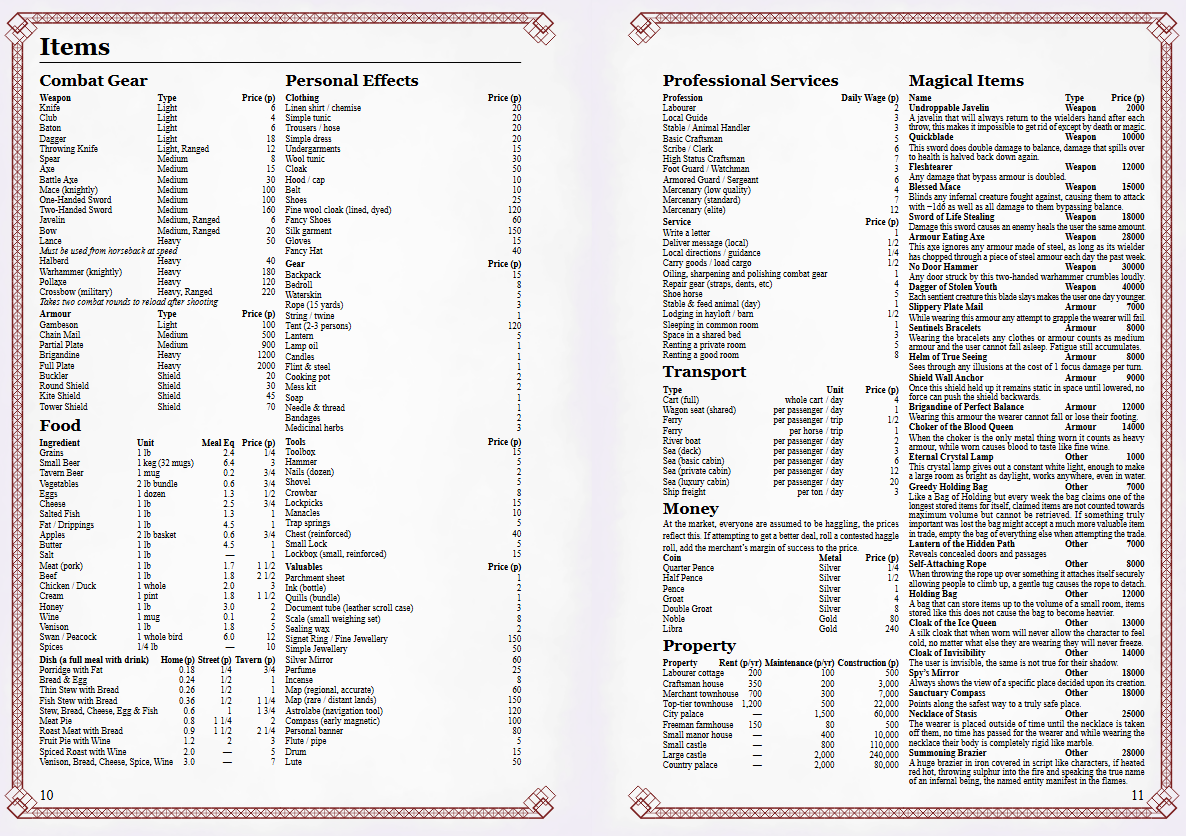
I was a bit suspicious even before the playtest; this was a tone break from the rest of the game, and the test confirmed it. I need to figure out an abstract system to handle money so that anyone not dirt poor does not have to count coins for buying food and drink at inns.
My current thinking is that what characters can own divides into a few categories: cash and other stores of value like jewels, gold rings, etc., property like houses, their adventuring gear including arms and animals, and any magical items they might possess. Any system should enable tracking all of them neatly.
I have been playing around with attaching the rules for trading as an ability of cash, this way I can cheat and keep the trading rules in the item chapter rather than moving them to the overcrowded rules chapter. As an added benefit, this also hides the trading rules from players whose characters never interact with money. Not fully committed yet, but it is tempting.
Regardless, I need to handle both small transactions like room and board, and large transactions like property, good arms and magical items. Whatever system I end up with needs to support both.
Cash also has the ability to combine into more cash. If the players repeatedly loot mid-size coin purses, at some point those should accumulate into a pile of coins one tier larger. I have not yet figured out how I want to model this, but the problem needs tackling. This ties into how many small transactions eventually accumulate into a large one. You can get your wage many times and at some point have enough to buy a house. Of course, in the modern day that includes credit, I will have to decide if that ends up included, the risk is always that I end up in the same mess I started with.
Hopefully I will be less starved of space for this spread as well, as I would like to space out the magical items significantly and probably add more data and descriptions to them. Ideally I will manage to fit the rules for cash and mundane items into one column and leave three columns for the magical item rules, the reverse of the current spread and much more in line with how player focus should be divided during the game.
/ Johan Burvall Mollevik